I finished reading The Pocket Book of Robert Frost’s Poems. If you read my previous post, “Why Collecting Books is only Half the Battle,” you would know that I found this book in a little book-house library in front of someone’s home. There are many of these mini libraries in “war ravaged” Portland, OR (I’ll be saying this until the madness ends). I’ve collected many books from these literary vessels, and I’m grateful to live in a city that loves books. If I owned a home, I would build one of these mini libraries.
Pocket Books a Brief History
Pocket Books are a division of Simon & Schuster. Mass production of these pocket sized books began in 1939. They originally cost $.25 cents and featured the logo of Gertrude the kangaroo reading a book with another book in her pouch. Gertrude was named after the mother-in-law of artist, Frank Lieberman (wikipedia). The publishing company changed hands a couple of times, but eventually returned to Simon & Schuster. They are still publishing pocket sized books today.
The Book
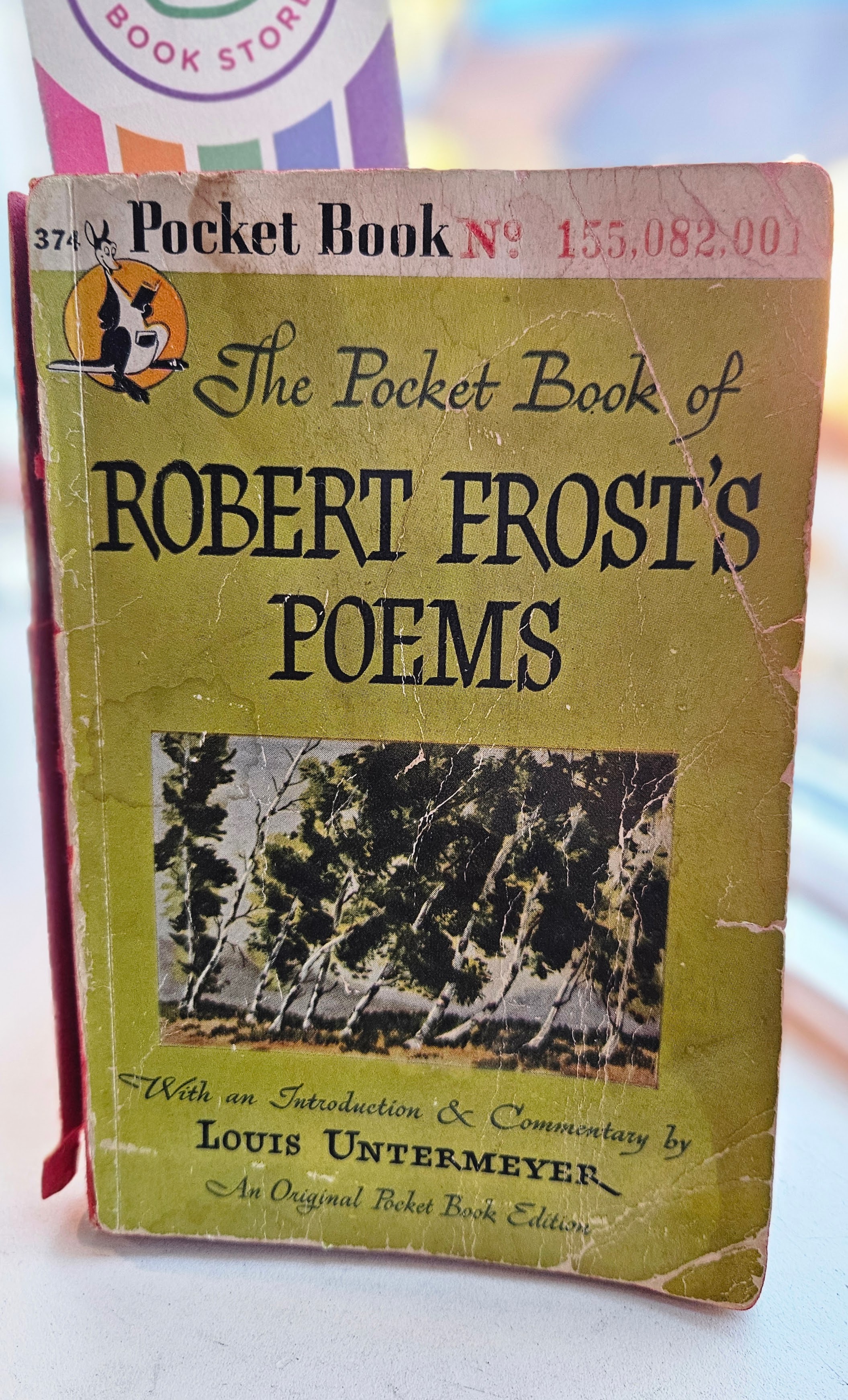
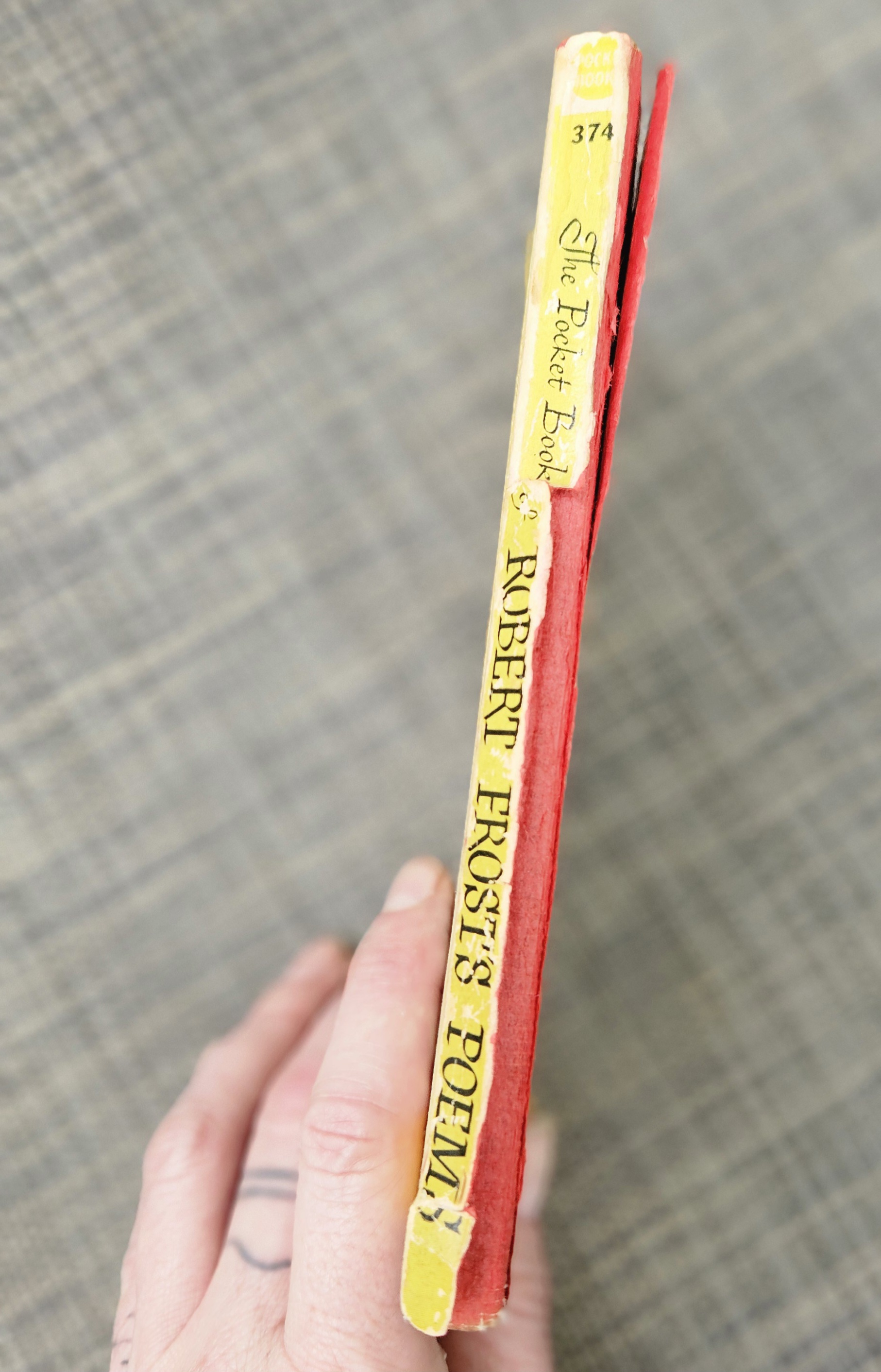
The Pocket Book of Robert Frost’s Poems that I have in my collection is number 375. You can find this number in the upper left hand corner of the cover next to the logo of Gertrude. You can also find the number at the top of the spine. At the upper right hand corner is the catalogue number 155,082,001 stamped in red. This number tells me that this is a reprinted edition.
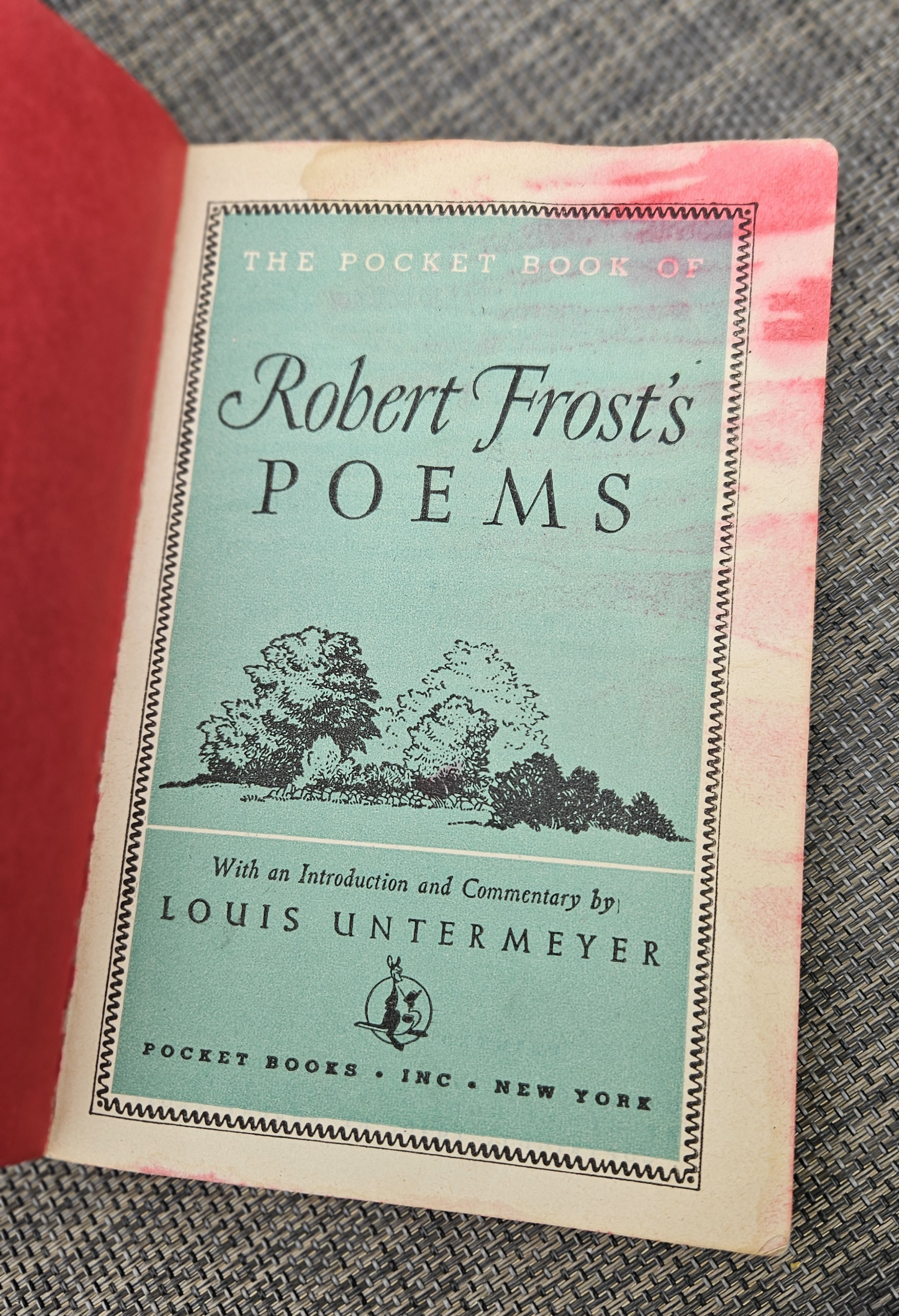
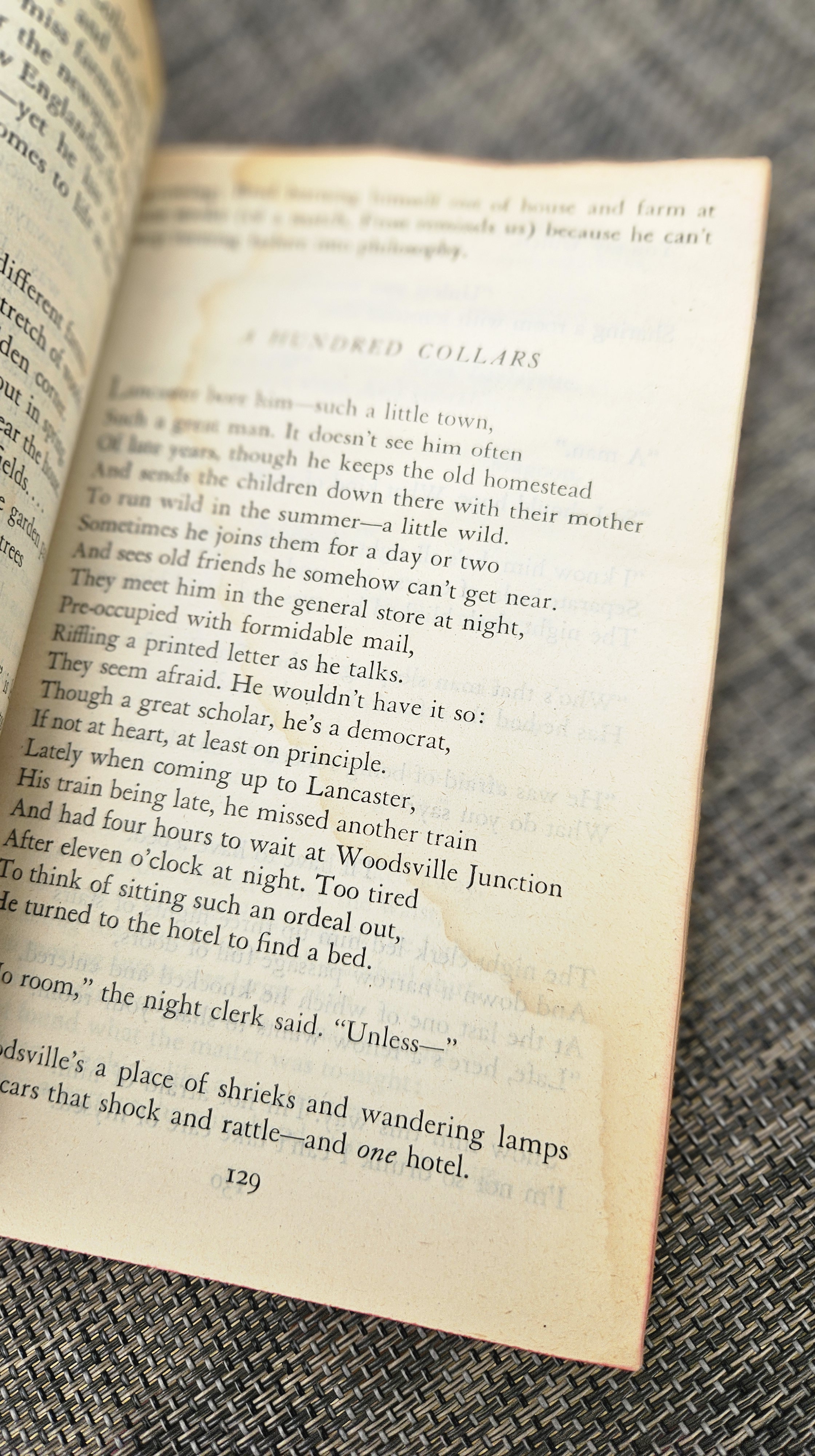
The book I have is damaged. The spine cover is torn reveling the blood red backing material. The cover is wrinkled and creased, and has a couple tiny tears on the edges. The end pages are a vibrant red. I described them as blood red, which is appropriate since the red dye has bled onto some of the other pages. There are light brown water stains on many pages, and they have the rippled effect that comes from once being wet. The book was outside when I found it so it is likely it was caught in the rain. Caught in the rain is unheard of in Portland. *wink-wink. The title page is smeared with red, but it doesn’t damage the lovely sea foam green of the illustration. Included on the title page is the title of the book and acknowledgment of the introduction and commentary by Louis Untermeyer. There is also the logo of Gertrude and Pocket Books . Inc . New York.

On the copyright page is the printing history. This collection of poems come from several of Robert Frost’s books including: A Boy’s Will, North of Boston, Mountain Interval, New Hampshire, West-Running Brook, A Witness Tree, and Come In. All of these books, none of which I have ever read, were published by Henry Holt and Co., Inc. Listed below the collection of books are all of the publication’s of Come In. One of the most interesting publications is the Armed Services edition published in October, 1944. This was right at the climax of the Pacific Theater of WWII. I picture all these young solders in the midst of war reading Robert Frost as a form of escape and connection to home. It’s hard for me to imagine a bunch of soldiers reading poetry today. Sadly.
The Pocket Book edition was published in May 1946. A first printing was April 1946 and a 2nd was September 1946. Other copyright dates refer to the publication of Come In, which included an introduction and a commentary by Louis Untermeyer. This pocket book edition is an extended edition of Come In. The copyright dates are as follows: 1930, 1939, 1943, 1946 by Henry Holt and company, Inc. Again in 1936, by Robert Frost.
All the poems are complete and unabridged. The illustrations are by John O’Hara Cosgrave II.
Table of Contents
The Table of Contents is divided into 7 sections, beginning with an introduction by Louis Untermeyer. Section I, titled An Invitation has one poem, “The Pasture”. Section II: titled, The Code and Other Stories, includes 13 poems. Section III: The Hired Man and Other People, includes 25 poems. One of which is my favorite poem, “Birches”. Section IV: Stopping by the Woods and Other Places, includes 21 poems, including the famous “Stopping by the Woods on a Snowy Evening”. Section V: The Runaway and Other Animals, includes 17 poems. Section VI: Country Things and Other Things, includes the famous, “The Road Not Taken”, “Nothing Gold Can Stay”, and 30 other poems. Section VII: An Afterward, has one poem; “Choose Something Like a Star”.
Commentary, Illustration, and Poetry
Louis Untermeyer (1885-1977)
An author, a poet, an editor, a translator, and an anthologist, Louis Untermeyer described himself as a “bone collector with the mind of a magpie” (Poetry Foundation). In 1916, he co-founded a poetry magazine titled, The Seven Arts. This magazine is credited with introducing many new poets, including Robert Frost.
In the 1950s he was blacklisted during McCarthyism for being a communist. He was not. Today, he would be considered a leftist, and/or a socialist. He was against war, spoke out against poverty and injustice. During McCarthyism loving your neighbor, wanting workers rights, and civil rights all meant you were a communist. Sound familiar? Things really do repeat.
During this period he was fired from a popular game show called “What’s My Line?” This unfair attack and loss of his job sent him into a deep depression. It was the famous playwright, Arthur Miller (another artist targeted by the U.S. government) who helped him come out of that dark place. Many people had their lives destroyed by Hoover and McCarthy. During the rise of fascism in America (circa 1950s) artists and intellectuals were the first on the chopping block. Fascists suppress voices of dissent, expression, and freedom to elevate the voices of repression. We see similar things happening today.
Lastly, he was a pun lover.
John O’Hara Cosgrave II(1908-1968)
An artist and a writer, who was best known for his illustrations of sea vessels (Archives West) That was the most I information I found on him on the internet, aside from his artwork. I think I would have better luck at the library.

Robert Frost (1875-1963)
Louis Untermeyer devoted 13 pages of introduction to the life of Robert Frost. I will go into detail of what those pages share in a future post. For now just the basics.
Robert Frost was born in 1875 in San Francisco, California. At age ten, after his father died from tuberculosis, his mother moved him to New England where both she and Frost’s father were born and raised. He was first published in the High School Bulletin at age 15. His first “professional” poem was published in The Independent when he was 19. His first book of poetry, A Boy’s Will was published when he was 38. He was awarded the Pulitzer Prize for the best book of poetry four times. He was nominated for the noble prize in literature 31 times. He was the Poet Laureate of Vermont. He died in 1963 at the age of 88, outliving his wife and 4 of his 6 children.
He prayeth best, who loveth best
All things both great and small.
                                     -Robert Frost
I mentioned that my favorite poem (at least before discovering all the poems in this book) is “Birches”. What is your favorite Robert Frost poem?
 A Chatoyant Fleck